Tree Cabling and Bracing Jacksonville FL is the proven solution when your property's most valuable trees show signs of structural weakness — split trunks, heavy limbs sagging over your home, or V-crotch unions flagged during inspections. Whether you're protecting a century-old live oak in Riverside or stabilizing storm-damaged trees in Mandarin, our ISA certified arborist team installs professional support systems that prevent catastrophic failure while preserving the trees you love. We serve Jacksonville, Atlantic Beach, Neptune Beach, Jacksonville Beach, Orange Park, and the greater Duval County area with licensed tree support services trusted by hundreds of property owners. When you need expert tree cabling in Jacksonville, you need a team that follows ANSI A300 standards and understands how Florida's hurricane season and native tree species create unique structural challenges. Don't wait until the next storm exposes your tree's weak points — call (904) 634-3474 today for a free structural assessment and protect your property before failure strikes.
Tree Support Systems Jacksonville: Cabling vs Bracing Explained
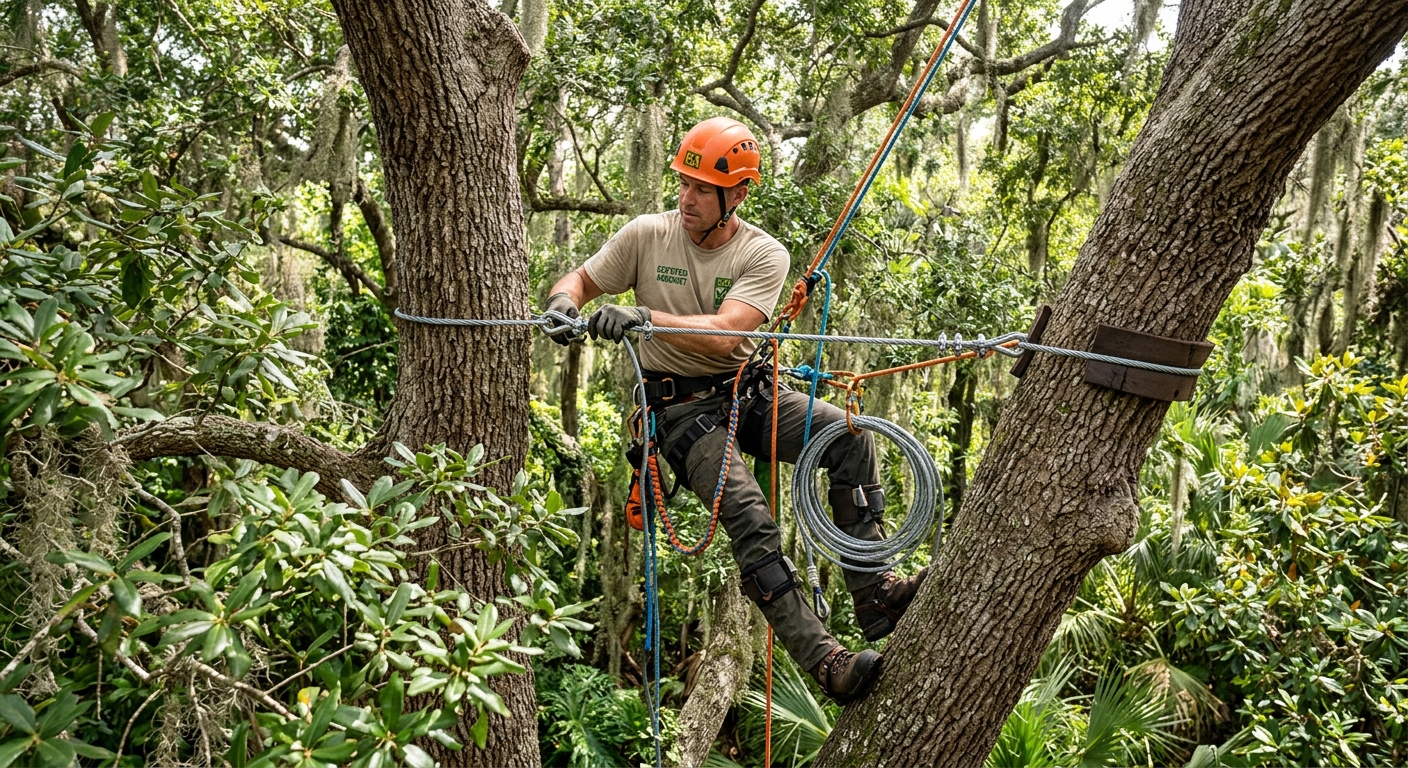
When your tree shows signs of structural defect, two main support systems can save it from removal: cabling and bracing. Understanding which system your tree needs — or whether it requires both — is critical for long-term stability and safety. Tree support systems Jacksonville arborists install are engineered solutions, not temporary fixes, and choosing the right approach depends on where the weakness exists and how the tree grows.
How Dynamic Cable Systems Protect Your Trees
Dynamic cable systems use flexible steel cables installed in the upper canopy to limit excessive branch movement during wind events and storms. We install cables at precisely two-thirds the distance between the weak union and the branch tip — this ANSI A300 standard placement provides optimal support without restricting the natural movement trees need to build strength. Unlike rigid systems, dynamic support allows 3-5% branch movement, which reduces stress on the attachment points and allows the tree to flex naturally during hurricanes. Our certified arborist team uses through-bolt installation with spacers to prevent bark girdling as your tree grows. This system works best for co-dominant stems where two leaders compete for dominance, creating weak attachment points prone to splitting. Jacksonville's signature live oaks, with their massive horizontal branches spreading 40-60 feet, benefit enormously from properly installed cabling — the system redistributes weight across multiple limbs and prevents catastrophic limb failure over homes, driveways, and outdoor living spaces. Annual inspections ensure cables maintain proper tension as your tree adds girth and weight each growing season.
When Tree Bracing Is the Right Choice for Split Trunks
Tree bracing uses rigid threaded rods installed horizontally through the trunk to pull split sections back together and prevent further separation. This system is essential when you have included bark — a condition where bark grows between two trunks or leaders, creating a weak seam instead of strong wood connection. If you've noticed a visible crack running vertically up your tree's trunk, especially after a storm, bracing may be your only alternative to removal. We drill carefully positioned holes through the trunk below the split, insert galvanized or stainless steel rods, and secure them with washers and nuts that compress the split sections together. Unlike cabling, which works in the canopy, bracing provides rigid structural support at the trunk level where splitting originates. Many Jacksonville homeowners discover split trunks in laurel oaks and water oaks after summer thunderstorms — these fast-growing species develop weak V-crotch unions that fail under wind load. Bracing stabilizes the split immediately and allows the tree to compartmentalize the wound while continuing to grow. In severe cases, we combine bracing rods with upper canopy cabling for complete structural support from trunk to crown.
ANSI A300 Standards: Why Proper Installation Prevents Failure
The difference between a tree support system that saves your tree and one that accelerates its failure comes down to following ANSI A300 Part 3 standards for installation. These industry standards specify cable placement height, hardware specifications, and load calculations based on species, branch diameter, and lean angle. Improper installation — using lag bolts instead of through-bolts, placing cables too high or too low, or failing to account for growth — creates new weak points that can cause limb failure faster than if you'd done nothing at all. We see the aftermath of DIY attempts and unlicensed tree service mistakes throughout Jacksonville: cables installed with rope or wire that girdles branches, lag bolts that create decay entry points, and systems placed at random heights without structural assessment. Our ISA certified arborist conducts a complete tree risk assessment before recommending cabling or bracing, measuring branch angles, checking for included bark, and calculating load distribution. Proper installation means your system will protect your tree for 15-20 years with annual maintenance, not create a new hazard. Every installation includes documentation of hardware specifications, placement measurements, and an inspection schedule — this protects you from liability and ensures the system performs as engineered during Jacksonville's hurricane season wind events.
Why Certified Arborist Tree Cabling Matters in Jacksonville
The certification level of who installs your tree support system directly affects whether it saves your tree or accelerates its failure. Certified arborist tree cabling follows engineering principles, species-specific knowledge, and safety standards that unlicensed services and DIY attempts cannot replicate. In Jacksonville, where structural support systems must withstand hurricane-force winds and support massive live oak limbs, cutting corners on expertise puts your property and family at serious risk.
ISA Certification: The Difference Between Expert and DIY Installation
ISA certified arborists have passed rigorous examinations covering tree biology, physics of failure, and proper support system installation techniques. This certification requires continuing education to maintain, ensuring your arborist stays current on the latest dynamic cable systems and installation methods. When our certified team assesses your tree, we're evaluating cambial growth patterns, calculating wind load based on Jacksonville's historical storm data, and identifying hidden structural defects like internal decay or root plate instability that affect whether cabling will succeed. We understand that live oaks develop reaction wood differently than laurel oaks, that included bark progresses at different rates in different species, and that cable placement must account for the tree's natural defense responses. A certified arborist knows that installing support during active spring growth can trigger compartmentalization failures, that cable tension must allow for seasonal movement, and that certain defects are too advanced for cabling to be effective. This expertise prevents you from investing in a system that's doomed to fail or — worse — creates a false sense of security while your tree remains a hazard. Every installation we perform includes a written assessment explaining why we chose cabling vs bracing, where we placed the hardware, and what ongoing maintenance the system requires.
Improper Cabling Mistakes That Accelerate Tree Failure
Improper tree cabling installation is worse than no support at all because it creates new failure points while giving you false confidence the tree is stable. The most common mistake we see in Jacksonville is using lag bolts screwed into the tree instead of through-bolts — lag bolts create stress concentration points and decay entry wounds that weaken the branch right where it needs strength. Another frequent error is placing cables too high in the crown where they provide minimal leverage, or too low where they restrict beneficial movement and create a fulcrum point for the branch to snap. DIY attempts often use wire rope from hardware stores without proper tensioning devices, leading to girdling as the branch grows or slack that provides no support during wind events. We've responded to emergency calls where homeowners used rope or chains "temporarily" that cut into the bark and killed the cambium layer, or where unlicensed services installed static systems that transferred all stress to a single attachment point. Some installers skip the structural assessment entirely and add cables to trees with root decay or advanced internal rot — the support system can't fix a tree that's failing from the root plate up. When we're called to assess these failed systems, removal is often the only safe option because the improper installation has created additional hazards while the original structural defect continued to worsen.
Licensed Installation Protects Your Property and Liability
Licensed tree support installation provides legal protection that matters if your tree fails and causes property damage or injury. Our licensed and bonded status means we carry full liability insurance covering our work — if a properly installed cable system fails due to installation error, you're protected. Unlicensed services and DIY installations leave you fully liable if the tree falls on a neighbor's property, vehicle, or person. In Jacksonville's historic neighborhoods like Avondale and Riverside, where protected tree ordinances require permits for work on heritage trees, licensed installation ensures you're in compliance with city regulations. Our documentation includes species identification, structural defect description, hardware specifications, and maintenance schedule — this record proves you took reasonable precautions to prevent tree failure, which is critical if liability questions arise after a storm. We also coordinate with your homeowner's insurance company when needed, providing the technical documentation adjusters require to approve claims related to tree support systems. Licensed installation means the work is inspected, follows engineering load calculations, and meets or exceeds industry safety standards. When you call (904) 634-3474, you're getting a team that's accountable to state licensing boards, insurance carriers, and industry certification bodies — not a handshake deal that disappears if something goes wrong.
Tree Preservation Jacksonville: Save Mature Trees Instead of Removal
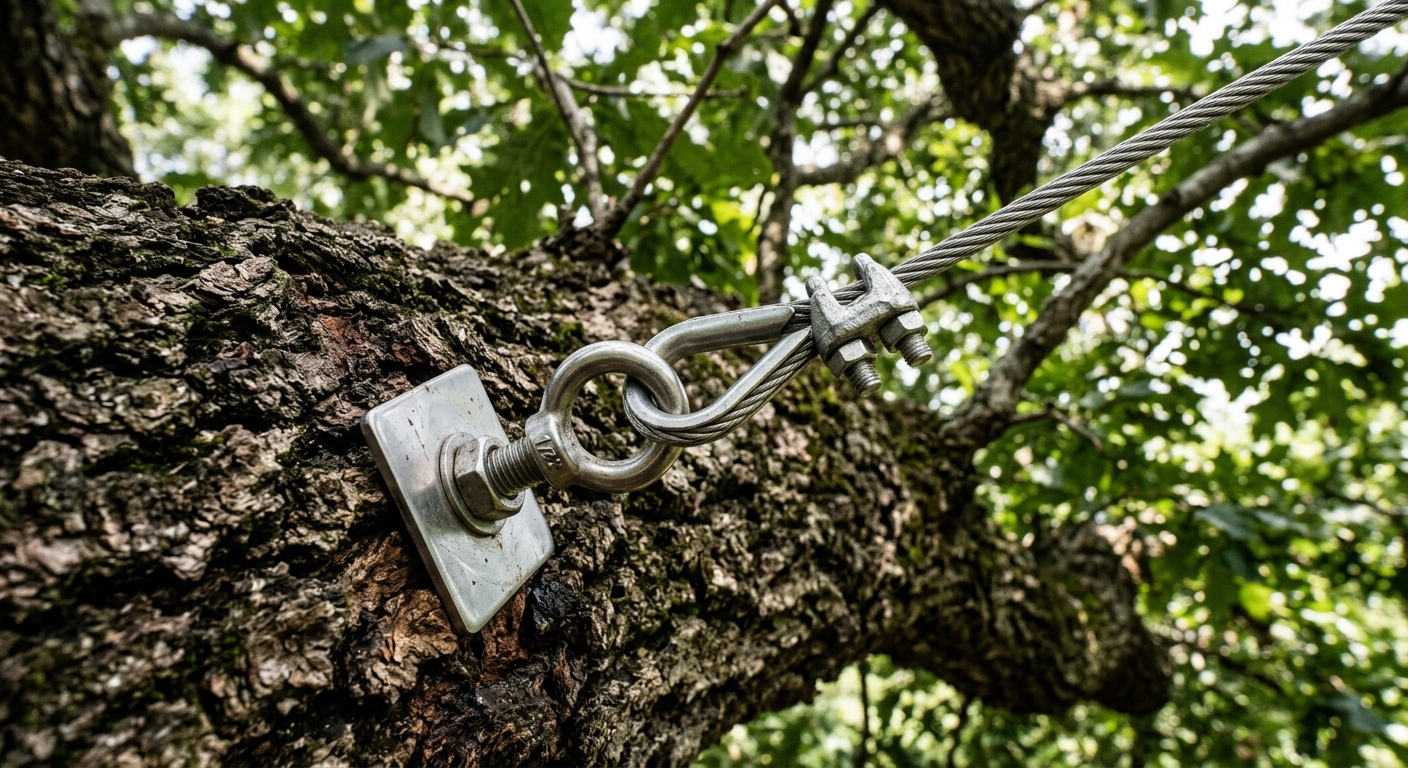
Tree preservation Jacksonville property owners pursue through cabling and bracing saves mature trees that would otherwise face removal — protecting property values, environmental benefits, and the irreplaceable character of established landscapes. When arborists recommend removal for structural defects, professional support systems offer a proven alternative that extends tree lifespan while maintaining safety. The decision to preserve rather than remove affects not just your property but Jacksonville's urban forest canopy that defines our neighborhoods and provides critical storm water management.
Heritage Live Oaks and Laurel Oaks: Structural Support for Jacksonville's Signature Trees
Jacksonville's heritage live oaks, some over 200 years old, develop structural challenges unique to their spreading growth habit — massive horizontal limbs extending 40-60 feet create leverage forces that exceed the strength of the branch attachment. These irreplaceable trees define neighborhoods like Riverside, Springfield, and San Marco, and their loss would fundamentally change the character and property values of these historic districts. Professional cabling stabilizes the weak unions where these horizontal giants attach to the trunk, allowing them to continue their growth for decades while protecting the homes and streets beneath them. Laurel oaks, another Jacksonville signature species, grow rapidly and develop co-dominant stems with included bark — the exact structural defect that cabling and bracing address. Rather than removing a 60-foot laurel oak that's shading your home and providing thousands of dollars in energy savings annually, support systems stabilize the weak union and prevent the split that would otherwise be inevitable. We've preserved heritage live oaks throughout Jacksonville that were slated for removal, using dynamic cable systems that respect the tree's natural movement while preventing catastrophic limb failure. These trees continue to increase property values, provide wildlife habitat, and define the visual landscape that makes Jacksonville neighborhoods desirable.
Extend Tree Lifespan 15-20 Years With Professional Cabling
Properly installed and maintained tree support systems extend your tree's functional lifespan by 15-20 years on average — often the difference between a tree reaching maturity and losing it in its prime. When we install cabling on a 40-year-old live oak showing early signs of weak branch unions, that tree can continue growing safely for another two decades with annual inspections and minor adjustments. This extension matters enormously for slow-growing species like live oaks that can take 50-75 years to develop their iconic spreading canopy. The alternative — removal and replacement with a young tree — means you'll never see a mature canopy in your lifetime, and your property loses the environmental services that mature tree provided: storm water absorption, air quality improvement, urban heat island mitigation, and energy cost reduction. Trees with support systems continue their normal biological functions, compartmentalizing wounds, adding growth rings, and expanding their root systems. The cables and bracing rods become integrated into the tree's structure as new wood grows around the hardware — they don't prevent growth, they guide it safely. Annual maintenance visits allow us to adjust cable tension as the tree adds girth, check for new defects developing, and verify the original structural issue remains stabilized. Many of the trees we first cabled 15 years ago are still thriving throughout Jacksonville, continuing to provide value to properties in Mandarin, Arlington, and Southside neighborhoods.
Cost Savings: Cabling vs Tree Removal in Jacksonville
Tree cabling cost Jacksonville homeowners invest in is typically 30-40% of what complete tree removal would cost for the same tree — and that's before factoring in stump grinding, debris removal, and the cost of replacing the lost tree. A mature tree removal in Jacksonville runs $2,500-$8,000 depending on size, location, and access, while professional cabling installation ranges $800-$2,500 for most residential trees. When you consider that the removed tree provided shade reducing your cooling costs by $200-400 annually, storm water absorption preventing drainage problems, and property value contribution estimated at $1,000-$10,000 depending on the tree and location, preservation becomes the clear financial choice. Trees near structures that require crane removal push costs even higher — we've seen removal quotes exceeding $12,000 for large live oaks with limbs over rooflines in areas like Ortega and Deerwood. Professional cabling saves these trees for a fraction of that cost while maintaining all their benefits. The annual inspection and maintenance cost for cabled trees is minimal — typically $150-250 per visit to check hardware, adjust tension, and verify stability. Over the 15-20 year extended lifespan a support system provides, you're investing roughly $3,000-5,000 total in annual maintenance, still far less than removal and replacement. For heritage trees in neighborhoods with protected tree ordinances, removal often requires expensive permits and mitigation planting requirements that double the true cost of cutting the tree down.
Emergency Tree Bracing Jacksonville: Storm Season Protection
Emergency tree bracing Jacksonville services provide critical stabilization when storms expose structural defects or create immediate failure risks that threaten your property. Jacksonville's hurricane season from June through November and severe thunderstorms year-round create urgent situations where professional emergency response prevents disaster. When your tree shows new cracks after a storm or begins leaning toward your home, immediate bracing and assessment can save both the tree and your property.
Hurricane Preparedness: Stabilize Structural Defects Before Storm Season
Hurricane preparedness in Jacksonville must include professional tree risk assessment and support system installation before storm season begins. Over 60% of tree failures during hurricanes involve trees with pre-existing structural defects — split trunks, weak branch unions, and co-dominant stems that catastrophic winds exploit. The time to identify and stabilize these defects is during the calm months of March through May, not when tropical storm warnings are posted. We conduct structural inspections throughout Jacksonville Beach, Ponte Vedra, and inland neighborhoods, identifying trees that won't survive hurricane-force winds without support. Once we've installed cabling and bracing, your trees can flex and sway during storms without the weak points separating and sending massive limbs crashing onto structures. Many homeowners discover structural problems only after a near-miss storm event reveals cracks or movement — these warning signs mean the next major wind event will likely cause complete failure. Pre-storm stabilization also protects you legally — if your tree falls on a neighbor's property and you knew about structural defects but took no action, you may be liable for damages. Our documentation provides proof that you took reasonable precautions to prevent failure. Schedule your pre-season assessment by calling (904) 634-3474 before June arrives and storm activity increases across the Atlantic basin.
24/7 Emergency Response for Storm-Damaged Trees
When storms hit Jacksonville and your tree suffers damage but hasn't completely failed, our 24/7 emergency tree bracing response provides immediate stabilization to prevent total loss. We respond throughout Duval County and surrounding areas during and immediately after severe weather events, installing emergency bracing and support cables on partially split trunks, storm-damaged limbs hanging over structures, and trees that have shifted or begun leaning. Emergency response focuses on immediate safety — removing the imminent threat to your home, vehicles, and family — followed by assessment of whether the tree can be permanently stabilized or requires removal once conditions allow. Many trees that would be lost entirely to emergency removal can be saved through rapid stabilization, especially if the structural failure is caught before the split propagates through the entire trunk. Our emergency service includes temporary bracing with adjustable support posts for leaning trees, cable installation to hold split sections together until permanent bracing can be installed, and crown reduction to remove weight from damaged areas. We work closely with homeowner's insurance companies during emergency calls, documenting damage and providing the technical assessments adjusters need. Emergency tree bracing services are available around the clock during active storm seasons — call (904) 634-3474 immediately if your tree shows new cracks, begins leaning, or has limbs hanging dangerously after severe weather strikes.
Post-Storm Assessment and Immediate Stabilization
Post-storm tree assessment reveals damage that's not immediately visible from the ground — internal splitting, root plate lifting, and hidden cracks in branch unions that will fail during the next wind event. After any significant storm affecting Jacksonville, property owners should schedule professional arborist inspection even if trees appear undamaged. We use resistant drilling and visual assessment techniques to identify internal decay and structural damage storms accelerate, checking root flare stability, inspecting branch unions for new cracks, and evaluating whether storm stress has advanced pre-existing defects beyond the point where support systems remain viable. Immediate stabilization after storms often means the difference between saving a tree and watching it slowly decline until removal becomes necessary. Trees showing partial root plate failure can be stabilized with guy-wire systems and root zone restoration. Split trunks caught early can be braced before the split propagates through the entire trunk. Storm-stressed trees in Southside, Mandarin, and Northside neighborhoods benefit enormously from rapid professional assessment — many trees we evaluate show damage that would become catastrophic failure within 6-12 months without intervention. Post-storm assessment also identifies trees that are beyond saving and pose immediate hazards, allowing you to prioritize removal safely before they fail unpredictably. Our assessment reports document tree-by-tree conditions with prioritized recommendations, helping you make informed decisions about which trees need emergency bracing, which can wait for standard cabling installation, and which must be removed for safety.
Tree Cabling Cost Jacksonville: Pricing and Value Breakdown
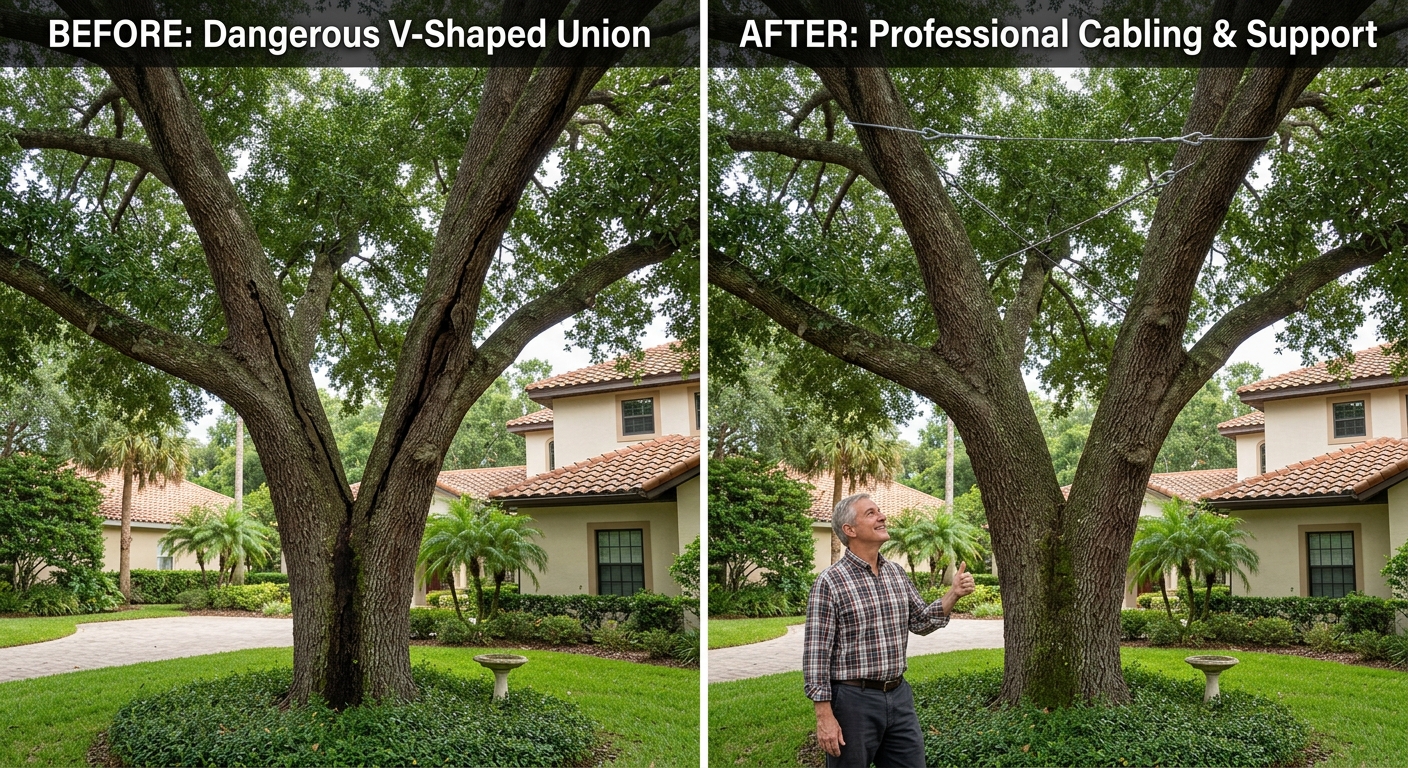
Tree cabling cost Jacksonville property owners can expect varies based on tree size, defect complexity, access difficulty, and the number of support systems required. Understanding what drives installation pricing helps you evaluate quotes and recognize the value professional systems deliver compared to inadequate low-cost alternatives. Investing in properly engineered support systems costs less than removal while preserving irreplaceable mature trees and protecting your property from damage.
What Affects Tree Support System Installation Cost
Several factors determine the final cost of tree cabling and bracing installation in Jacksonville. Tree height and canopy spread directly impact labor time and equipment requirements — a 60-foot live oak with 80-foot spread requires more climbing time, additional hardware, and potentially multiple cable installations compared to a 30-foot tree with localized defect. The severity and location of the structural defect matters significantly: a single weak branch union accessible from the ground costs far less to cable than multiple co-dominant stems requiring work throughout the upper canopy. Access difficulty drives cost substantially — trees in fenced backyards with limited equipment access require more manual labor than trees accessible from the street with clear crane positioning. The number of cables and bracing rods required varies by tree — some trees need a single support cable, while complex multi-stem trees may need 3-4 cables plus rigid bracing rods to fully stabilize the structure. Hardware quality affects pricing as well: we use marine-grade stainless steel hardware that won't corrode in Jacksonville's humid climate, which costs more initially but eliminates the need for premature replacement. Species matters because some trees like live oaks have dense wood requiring more time to drill through for through-bolt installation, while fast-growing species like laurel oaks may need more aggressive bracing approaches. Distance from our service area affects travel time — we serve all of Jacksonville and surrounding communities, but properties in distant areas like Fernandina Beach or St. Augustine may include additional travel charges.
Budget-Friendly Alternative to Tree Removal
Professional tree support systems provide a budget-friendly alternative when the only other option is expensive tree removal. Where removal of a large mature tree costs $3,000-$8,000 or more, cabling installation typically ranges $800-$2,500 depending on the factors above. This cost difference becomes even more dramatic when you factor in the value the preserved tree continues to provide: shade that reduces cooling costs, storm water management that prevents drainage problems, property value contribution that real estate appraisers recognize, and the aesthetic character that defines desirable Jacksonville neighborhoods. Removing a heritage live oak and replacing it with a young tree means you'll never see a mature canopy again in your lifetime — these trees grow slowly and take 50-75 years to develop their iconic form. The new tree won't provide meaningful shade or storm water absorption for 15-20 years. When you preserve the existing mature tree through support systems, you maintain all these benefits immediately while spending a fraction of removal cost. Many Jacksonville homeowners discover that their insurance policies cover tree support installation as preventive maintenance, especially when an arborist documents that the tree poses a risk to insured structures. Check with your carrier before assuming support systems aren't covered — you may find that your policy includes tree preservation benefits that significantly reduce your out-of-pocket cost. We provide detailed written quotes breaking down labor, hardware, and ongoing maintenance costs so you can make informed decisions. Call (904) 634-3474 for a free assessment and accurate pricing specific to your tree's conditions.
Maintenance Plans and Annual Inspection Pricing
Tree support system maintenance plans provide annual inspections and adjustments that keep your investment performing as designed for decades. Annual inspection pricing typically ranges $150-250 per visit, during which we check cable tension, verify hardware integrity, look for girdling or growth interference, assess whether the original structural defect has progressed, and identify any new issues developing in other parts of the tree. These annual visits are essential because trees grow continuously — cable tension that was perfect at installation may need adjustment after a year of diameter growth. We check for bark growing over hardware that might restrict further expansion, verify that bolts remain properly torqued, and confirm the support system still provides adequate load distribution as the tree's weight and form change. Maintenance plans also include storm season preparedness checks before June and post-storm assessments after significant weather events. Many Jacksonville property owners enroll multiple trees in annual plans, receiving discounted per-tree pricing when we service several trees during a single visit. These plans typically cost $400-800 annually for properties with 2-4 supported trees, far less than the risk of system failure or the cost of emergency repairs. Maintenance visit documentation updates your tree's service history, which proves valuable if you sell the property or need to demonstrate proper care during insurance claims. Our maintenance agreements include priority scheduling during storm season and guaranteed response times for emergency issues affecting trees under active management. Proper maintenance dramatically extends the functional life of support systems — we regularly service cables installed 15+ years ago that continue performing perfectly because they've received consistent professional attention.
Why Jacksonville Property Owners Trust Our Arborist Team
Jacksonville property owners across Riverside, Mandarin, Jacksonville Beach, Atlantic Beach, Neptune Beach, and throughout Duval County trust Tree Service Jacksonville FL because we combine technical expertise with proven local experience and complete accountability. When your property's most valuable trees need professional structural support, you need an arborist team with the credentials, equipment, and track record to deliver permanent solutions that protect what matters most.
500+ Trees Stabilized Across Jacksonville Neighborhoods
Our team has stabilized over 500 trees throughout Jacksonville neighborhoods since we began specializing in structural support systems. From heritage live oaks in historic Avondale to storm-damaged laurel oaks in Southside subdivisions, we've addressed every type of structural defect Florida's native and landscape trees develop. This extensive local experience means we've encountered and solved the specific challenges Jacksonville's climate, soil conditions, and storm patterns create. We know which species develop weak branch unions most frequently, how quickly structural defects progress in our humid environment, and which support system configurations perform best during hurricane-force wind events. Every installation we've completed provides learning that improves our techniques — we've refined our cable placement approaches based on how Jacksonville trees respond and grow, adjusted our hardware specifications based on long-term performance in coastal conditions, and developed assessment protocols specific to the structural patterns we see repeatedly in local species. Property owners throughout Orange Park, Fleming Island, and St. Johns County request our services because they've seen our work on neighbors' trees or received referrals from satisfied customers. Many of the trees we first cabled over a decade ago continue thriving today with regular maintenance, providing living proof that professional support systems deliver the long-term protection we promise.
Full Insurance Coverage and Liability Protection
Full insurance coverage and comprehensive liability protection distinguish professional arborist services from unlicensed competitors and DIY attempts. Tree Service Jacksonville FL carries general liability insurance covering property damage and injury claims up to $2 million, plus workers compensation insurance protecting our crew members during the inherently risky work of installing support systems in large trees. This coverage protects you completely — if a branch falls during installation and damages your roof, we're covered; if hardware fails due to improper installation and the tree damages a neighbor's property, we're covered; if a crew member is injured while working on your property, our workers comp prevents you from facing a lawsuit. We provide certificates of insurance before beginning any work, and our policies name you as an additional insured party during active projects. This level of protection simply doesn't exist with unlicensed services or casual laborers who may have minimal coverage or none at all. Beyond insurance, we maintain comprehensive documentation of every installation — before photos, structural assessment reports, hardware specifications, placement measurements, and maintenance schedules — that protects you from liability claims if a supported tree later fails due to factors beyond our control. This documentation proves you took reasonable precautions and hired qualified professionals, which courts and insurance companies recognize as fulfilling your duty of care.
Licensed, Bonded, and ISA Certified Since 2006
Tree Service Jacksonville FL has served the Jacksonville area since 2006 with fully licensed, bonded, and ISA certified arborist expertise. Our 18+ years in business mean we've weathered multiple hurricane seasons, responded to countless storm emergencies, and built relationships with thousands of satisfied property owners who trust us to protect their most valuable trees. ISA certification requires rigorous examination demonstrating comprehensive knowledge of tree biology, structural assessment techniques, and proper support system installation methods. Our arborists maintain this certification through continuing education requirements that keep us current on the latest industry standards, research developments, and installation innovations. Being bonded provides additional financial protection — the surety bond guarantees we'll complete work as contracted and provides recourse if we fail to meet our obligations. Our licensing with the state of Florida requires background checks, demonstrated competency, and adherence to regulatory standards that protect consumers from unqualified operators. We're members in good standing with the International Society of Arboriculture and follow their Best Management Practices for all tree care operations. When you call (904) 634-3474, you're contacting a business with nearly two decades of proven Jacksonville service, not a startup operation learning on your trees. Our longevity proves we deliver the quality and reliability that keeps customers returning and referring neighbors, family, and colleagues.
Request Your Free Tree Assessment — Call Today
Don't wait until your structurally compromised tree fails during the next storm to take action. Request your free tree assessment today and get expert evaluation of whether cabling, bracing, or support systems can save your tree and protect your property. Tree Service Jacksonville FL provides no-obligation structural inspections throughout Jacksonville and surrounding areas, giving you the information you need to make informed decisions about tree preservation vs removal.
Schedule a Structural Inspection in Your Neighborhood
We're currently scheduling structural tree inspections throughout Riverside, Mandarin, Jacksonville Beach, Atlantic Beach, Neptune Beach, Orange Park, Southside, Northside, Arlington, and all of greater Duval County. Our certified arborist will visit your property, assess the trees showing signs of structural weakness, identify the specific defects creating failure risk, and explain whether professional support systems can stabilize the tree safely. The inspection includes visual assessment of branch unions, checking for included bark and co-dominant stems, resistance drilling when internal decay is suspected, and evaluation of root plate stability. You'll receive a detailed written assessment explaining what we found, why the structural defect developed, what support system we recommend, and what the installation and maintenance will cost. This comprehensive evaluation gives you all the information needed to compare options and make the right decision for your property. We'll also identify other trees on your property that may have developing structural issues not yet obvious, allowing you to address problems before they become emergencies. Call (904) 634-3474 today to schedule your free inspection — appointments are available throughout the week including Saturdays for your convenience.
Same-Day Quotes for Cabling and Bracing Work
We provide same-day quotes following your structural tree inspection so you can move forward immediately with cabling and bracing installation. Our quotes include itemized pricing for labor, hardware, equipment, and any crane or specialized access requirements. You'll know exactly what the installation costs, what the annual maintenance will run, and what timeline to expect from approval to completion. We explain every line item so you understand what you're paying for and why quality installation costs more than cut-rate alternatives that fail. The quote includes our recommended installation schedule — some work should happen immediately before storm season, while other installations are better performed during dormant winter months when tree stress is minimal. We'll coordinate with your schedule to minimize disruption and complete work when it's most convenient for your household. Our quotes are valid for 30 days, and we honor them even if we can't schedule your installation immediately. Many property owners request quotes for multiple trees during a single visit, allowing us to provide package pricing that reduces per-tree costs. We never pressure you to approve work on the spot — take time to review the assessment, compare it with other qualified arborists if you wish, and contact us when you're ready to move forward. We're confident our combination of expertise, equipment, and fair pricing makes us the right choice for tree support installation throughout Jacksonville.
Emergency Services Available 24/7 During Storm Season
Emergency tree bracing and stabilization services are available 24/7 during Jacksonville's active storm season from June through November and year-round for severe weather events. When storms damage your trees or create immediate failure risks, call (904) 634-3474 for rapid response throughout Jacksonville and surrounding communities. Our emergency crews respond with the equipment and expertise to stabilize partially failed trees, remove immediate threats hanging over structures, and assess whether damaged trees can be saved through emergency bracing and support. We prioritize calls where trees pose imminent danger to occupied structures, and we'll arrive as quickly as conditions safely allow. Emergency response includes temporary stabilization measures to make the situation safe, followed by detailed assessment of permanent repair options once the immediate crisis passes. Many trees we stabilize during emergency calls go on to full recovery with proper support systems and ongoing care. Our emergency service includes coordination with your insurance company's storm damage claims process, providing documentation and technical assessment adjusters require. Don't attempt to handle storm-damaged trees yourself — the risk of further failure during DIY stabilization attempts causes serious injuries every storm season. Professional emergency response protects you, your family, and your property while giving damaged trees the best chance at survival. Contact us now to schedule your free structural assessment or for immediate emergency assistance when storm damage strikes.