Tree Service vs DIY: What You Need to Know in Jacksonville FL comes down to safety, cost, and whether your tree work crosses the line from simple yard maintenance into dangerous territory. Jacksonville homeowners face unique challenges when deciding between professional tree removal and DIY approaches — from hurricane-damaged oaks to protected heritage trees requiring permits. The decision you make affects your wallet, your liability, and potentially your safety. If you have a tree taller than your roof, near power lines, or damaged by storm winds, calling a professional isn't just smart — it's the only safe choice. For smaller pruning jobs and low-hanging branches, DIY might work, but only if you understand the risks and have the right equipment.
When to Call a Tree Service vs DIY in Jacksonville
Knowing when to tackle tree work yourself versus calling a professional tree service in Jacksonville depends on height, complexity, and proximity to structures or power lines. The line between a manageable DIY project and a dangerous situation is clearer than most homeowners realize. If you're standing on the ground with both feet and using a pole pruner to reach branches under 10 feet, you're likely in safe DIY territory. The moment you need a ladder taller than 6 feet or a chainsaw above shoulder height, you've entered professional-only work.
Small Pruning and Branch Trimming You Can Handle Safely
Small pruning tasks — trimming shrubs, cutting branches thinner than your wrist, and removing deadwood within arm's reach — are safe DIY projects for Jacksonville homeowners. You can handle these jobs with basic hand tools: bypass pruners for branches up to ¾ inch, loppers for limbs up to 2 inches, and a pole pruner for anything within 10 feet of the ground. The key rule: if you can reach it without a ladder and it's smaller than 3 inches in diameter, you're in the safe zone. Always check for power lines before cutting, even on small branches. Jacksonville's tree canopy often grows close to overhead utilities, and one misstep can turn a simple pruning job into an electrocution hazard.
- Use sharp bypass pruners for clean cuts that heal properly
- Make cuts at a 45-degree angle just outside the branch collar
- Never top trees — remove entire branches back to the trunk or a lateral branch
- Wear safety glasses and gloves for every cut, no matter how small
- Avoid pruning during Jacksonville's summer thunderstorm season when lightning strikes are common
Tree Removal and Large Limbs: Why Professionals Matter
Tree removal and cutting large limbs require professional equipment, training, and liability insurance that Jacksonville homeowners don't possess. A mature live oak — one of the most common trees in Jacksonville yards — can weigh 20 tons or more. When you cut into a trunk under tension, the tree doesn't fall predictably. Barber chair splits, where the trunk explodes vertically as you cut, kill multiple people every year. Professional arborists assess weight distribution, lean angle, and internal decay before making the first cut. They use ropes, pulleys, and directional felling techniques that take years to master. If your tree is taller than 15 feet, within 20 feet of your house, or near power lines, calling a certified arborist isn't optional — it's the only way to avoid catastrophic property damage or injury.
- Professionals carry $1–2 million in liability insurance covering property damage
- Certified arborists identify hidden decay, weak unions, and structural defects you can't see
- Bucket trucks and aerial lifts eliminate fall risks from ladder work
- Wood chippers and stump grinders complete the job in hours, not days
- Licensed tree removal companies handle permit applications for protected species
Quick Decision Framework: DIY or Professional Service
Use this framework to decide whether to hire a tree service or attempt DIY tree work in Jacksonville. Ask yourself four questions: Is the branch or tree taller than 10 feet? Does the work require a chainsaw above your head? Is the tree within 20 feet of a structure, fence, or power line? Does the tree show storm damage, leaning, or dead sections? If you answered yes to even one question, hire a professional. DIY tree work is appropriate only for ground-level pruning, small branch removal with hand tools, and maintenance tasks that don't require climbing or power equipment. When in doubt, get a free estimate from a licensed tree service — most companies in Jacksonville offer same-day quotes and can assess whether your project is genuinely DIY-safe or requires professional intervention. Don't let pride or cost anxiety push you into a dangerous situation.
If you're uncertain about your tree project, call (904) 634-3474 for a free safety assessment. Our ISA-certified arborists serve Jacksonville, Southside, Arlington, and surrounding neighborhoods with honest advice — even if that means telling you the job is safe to DIY.
Cost Breakdown: Professional Tree Service vs DIY in Jacksonville
Understanding the real cost comparison between professional tree service and DIY work in Jacksonville requires looking beyond the initial sticker price of hiring a crew. Most homeowners focus on the upfront cost of professional removal — typically $450 to $1,200 for a medium-sized tree — and assume DIY will save hundreds of dollars. The reality is far different once you factor in equipment rental, disposal fees, time off work, and the potential for property damage that costs thousands to repair. Professional tree removal includes liability insurance, debris hauling, stump grinding options, and guaranteed completion. DIY costs multiply quickly when you rent a chainsaw for $75/day, a wood chipper for $150/day, and spend an entire weekend (plus the following week) managing a project that professionals finish in 3–4 hours.
What Professional Tree Removal Actually Costs in Jacksonville
Professional tree removal in Jacksonville ranges from $300 for a small ornamental tree under 20 feet to $2,500+ for a massive live oak exceeding 60 feet with multiple trunks. The average cost for a typical 30–40 foot tree with moderate access is $650–$900, including cutting, debris removal, and hauling. Stump grinding adds $100–$300 depending on diameter. Companies charge more for trees near structures, over roofs, or tangled in power lines because the work requires rigging, ropes, and piece-by-piece dismantling instead of simple felling. Emergency storm damage removal costs 50–100% more due to the urgency and increased risk of working with unstable, partially failed trees. Most Jacksonville tree services offer free estimates and can provide same-day quotes for standard residential work. You're paying for liability insurance that covers your property, professional-grade equipment, and crews trained in aerial lift operation and advanced rigging techniques.
- Small trees (under 20 feet): $300–$500
- Medium trees (20–40 feet): $650–$1,200
- Large trees (40–60 feet): $1,200–$2,000
- Extra-large heritage oaks (60+ feet): $2,000–$5,000+
- Emergency storm removal: add 50–100% to standard rates
Hidden Costs of DIY Tree Work: Equipment Rental and Disposal Fees
Hidden costs of DIY tree work pile up faster than Jacksonville homeowners expect, often erasing any savings over hiring a professional. Start with equipment rental: a homeowner-grade chainsaw costs $60–$90 per day, safety gear (helmet, chaps, gloves, eye protection) runs $150–$200 to purchase, and a ladder tall enough to reach a 25-foot tree rents for $40–$60 per day. If you need a wood chipper to handle debris, expect $150–$250 per day — and most residential jobs take 2–3 days for inexperienced users. Jacksonville requires yard waste permits for curbside pickup of large volumes; private debris hauling costs $200–$400 for a single truckload. Stump grinder rental costs $100–$200 per day, and operating one without experience often takes an entire day to remove a single stump that professionals finish in 20 minutes. Add lost wages if you take time off work, and DIY costs frequently match or exceed professional pricing — with none of the insurance protection or guaranteed results.
- Chainsaw rental: $75/day × 2–3 days = $150–$225
- Wood chipper rental: $200/day × 2 days = $400
- Safety gear purchase: $150–$200 (helmet, chaps, gloves, goggles)
- Stump grinder rental: $150/day
- Debris hauling/disposal: $200–$400 per load
- Lost wages: 2–3 days off work = $300–$800+ for many homeowners
Why DIY Isn't Always Cheaper When You Factor in Time and Risk
DIY tree removal seems cheaper until you calculate the value of your time and the financial risk of property damage. A professional crew removes a 35-foot tree, chips the debris, and hauls everything away in 3–4 hours. The same job takes an inexperienced homeowner 12–20 hours spread across multiple days — that's a full weekend plus additional evenings, assuming nothing goes wrong. If you earn $25/hour at your job, those 20 hours represent $500 in lost earning potential. Now factor in risk: one miscalculated cut that drops a 500-pound limb onto your fence costs $800–$1,500 to repair. A tree that falls onto your roof causes $5,000–$15,000 in damage that your homeowner's insurance may not cover if you caused it through DIY negligence. Professional tree services carry $1–2 million in liability coverage protecting your property. The "savings" of DIY evaporate the moment anything goes wrong — and in tree work, things go wrong frequently even for experienced arborists.
Get a transparent cost breakdown for your Jacksonville tree project by calling (904) 634-3474. We provide itemized quotes showing exactly what you're paying for — no hidden fees, no surprises.
Safety Risks: Why DIY Tree Work Can Be Dangerous in Jacksonville
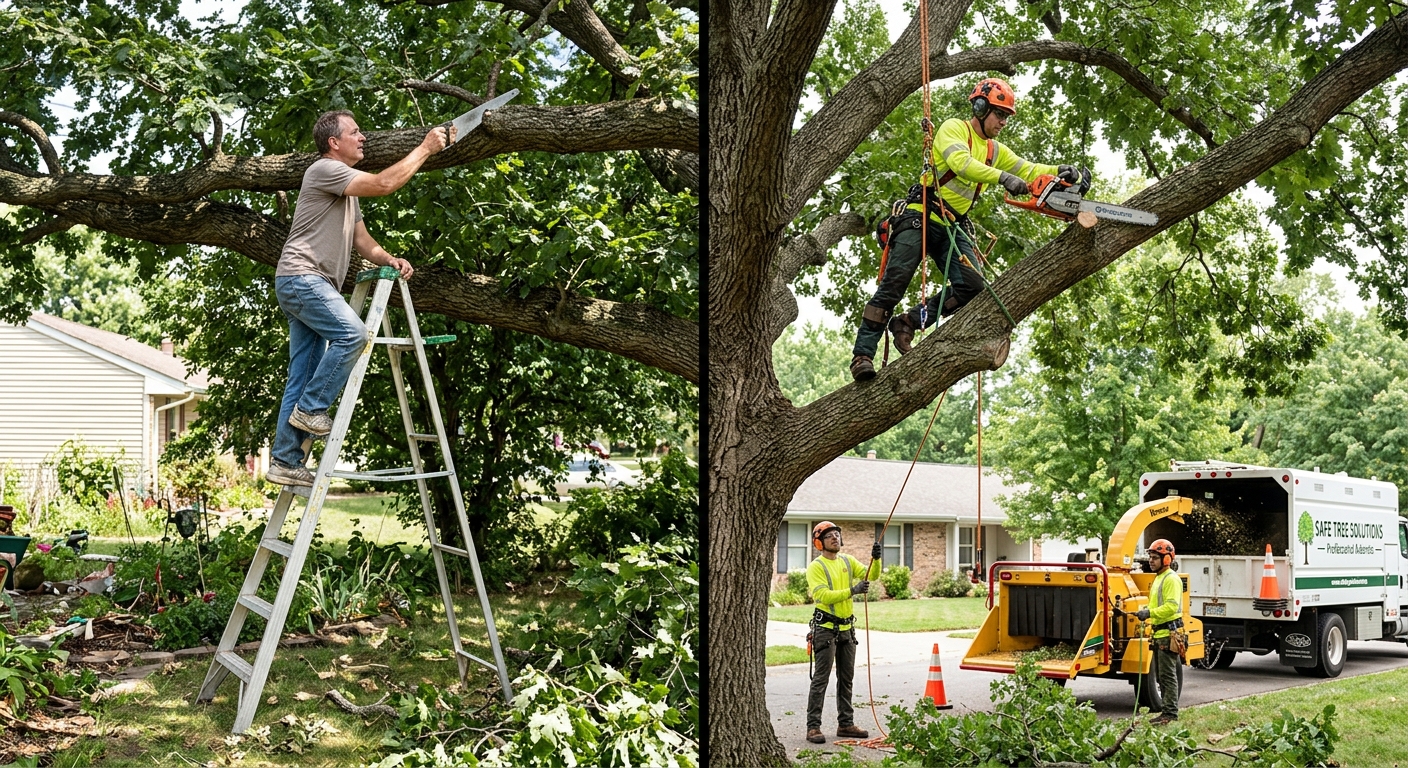
Safety risks make DIY tree work one of the most dangerous tasks Jacksonville homeowners attempt, ranking alongside roofing and electrical work for injury rates. Tree work combines fall hazards, chainsaw injuries, unpredictable wood behavior under stress, and the constant threat of electrocution from overhead power lines. Unlike other home improvement projects where mistakes cost money but not limbs, tree removal errors cause severe injuries or death. The Occupational Safety and Health Administration reports that tree care work has one of the highest fatality rates of any profession — over 100 deaths annually in the U.S., with falls and struck-by injuries accounting for 75% of fatalities. Jacksonville's specific conditions — sandy soil that destabilizes root systems, hurricane-weakened limbs, and dense canopy growth near power lines — add layers of risk that most homeowners don't recognize until a 200-pound branch drops unexpectedly.
Common Tree Work Injuries: Falls, Electrocution, and Cuts
Common tree work injuries — falls from ladders, chainsaw cuts, and electrocution from power lines — send thousands of Jacksonville homeowners to emergency rooms every year. Falls account for the majority of serious injuries when ladders tip as branches shift weight or when homeowners lose balance while cutting overhead. Chainsaw kickback happens when the chain's top edge catches on wood and violently throws the saw backward toward the operator's face or chest; even experienced users suffer kickback injuries when cutting under tension or hitting hidden knots. Electrocution occurs when tree limbs contact overhead power lines during cutting or falling — many Jacksonville neighborhoods have utility lines running through mature oak canopies, and even brief contact can deliver lethal voltage. Struck-by injuries happen when falling limbs hit the cutter or bystanders; a 6-inch diameter branch weighs 50–100 pounds and falls at 30+ mph, causing skull fractures and internal injuries.
- Falls from ladders cause fractures, spinal injuries, and head trauma — heights above 10 feet are frequently fatal
- Chainsaw kickback lacerations require 50–100+ stitches and often damage facial nerves
- Electrocution from power line contact causes cardiac arrest and severe burns
- Struck-by injuries from falling limbs result in concussions, broken bones, and crush injuries
- Eye injuries from sawdust and wood chips can cause permanent vision loss
Jacksonville's Hurricane Season: Why Storm-Damaged Trees Are Extra Risky
Jacksonville's hurricane season from June through November creates storm-damaged trees that are exponentially more dangerous than healthy specimens for DIY removal attempts. When tropical storms and hurricanes pass through Northeast Florida, high winds stress tree trunks and create internal cracks called shake that aren't visible from the outside. Limbs may appear intact but are hanging by a thin layer of bark, ready to drop without warning when you start cutting. Salt spray from storm surge weakens oak and pine foliage, causing delayed branch death that makes weight distribution unpredictable months after the storm. Root systems loosen in Jacksonville's sandy soil during heavy rain, leaving trees with compromised stability that can tip unexpectedly when you remove counterbalancing branches. Professional arborists use tension assessment and crane-assisted removal for storm-damaged trees; DIY attempts frequently result in sudden limb drops, barber chair splits, and trees falling in unintended directions.
- Storm-stressed trees contain hidden cracks and internal failures invisible from ground level
- Widow-makers (partially broken limbs caught in canopy) drop without warning during cutting vibration
- Loose root systems in sandy Jacksonville soil make storm-damaged trees tip unpredictably
- Saltwater exposure from storm surge weakens branch unions for months after the event
- Leaning trees under tension can split explosively when you make relief cuts
Barber Chair Splits and Other Unpredictable Tree Failures
Barber chair splits — when a tree trunk violently splinters and kicks upward as you cut — are one of the most terrifying and deadly unpredictable tree failures that DIY cutters encounter. This happens when you cut into a leaning or tension-loaded tree without proper relief cuts; as the trunk splits, thousands of pounds of energy release instantly, sending the butt of the tree shooting 10–20 feet upward and backward. The result is almost always catastrophic injury or death to anyone standing near the stump. Other unpredictable failures include hung trees (trees that fall into other trees instead of the ground), root plate blowouts where the entire root system lifts out of Jacksonville's sandy soil as the tree tips, and compression failures where dead internal wood collapses mid-cut, pinching the saw blade and causing violent kickback. Professional arborists use bore cuts, back cuts, and wedges to control these forces; YouTube tutorials don't prepare homeowners for the physics of 5-ton trees under asymmetric load.
If your Jacksonville tree shows storm damage, lean, or dead sections, call (904) 634-3474 for a professional safety assessment. Our certified arborists identify hidden hazards that can turn a DIY project into a tragedy.
Equipment Needed for DIY Tree Work (And What Professionals Use)
Equipment requirements reveal the massive gap between DIY tree work capabilities and professional tree service tools used in Jacksonville. Homeowners attempting tree removal typically rent a consumer-grade chainsaw, buy basic safety gear, and hope a standard extension ladder reaches high enough. This setup handles small pruning but fails completely for real tree removal. Professional arborists arrive with $100,000+ in specialized equipment: bucket trucks for safe aerial access, commercial-grade chainsaws with 20+ inch bars, stump grinders with carbide teeth, wood chippers that process 6-inch diameter limbs, rigging ropes rated for 5,000-pound loads, and climbing harnesses certified for fall protection. The equipment difference isn't just about speed — it's about controlling forces and accessing heights that are physically impossible with rental gear.
Essential Safety Gear: Helmets, Harnesses, and Protective Clothing
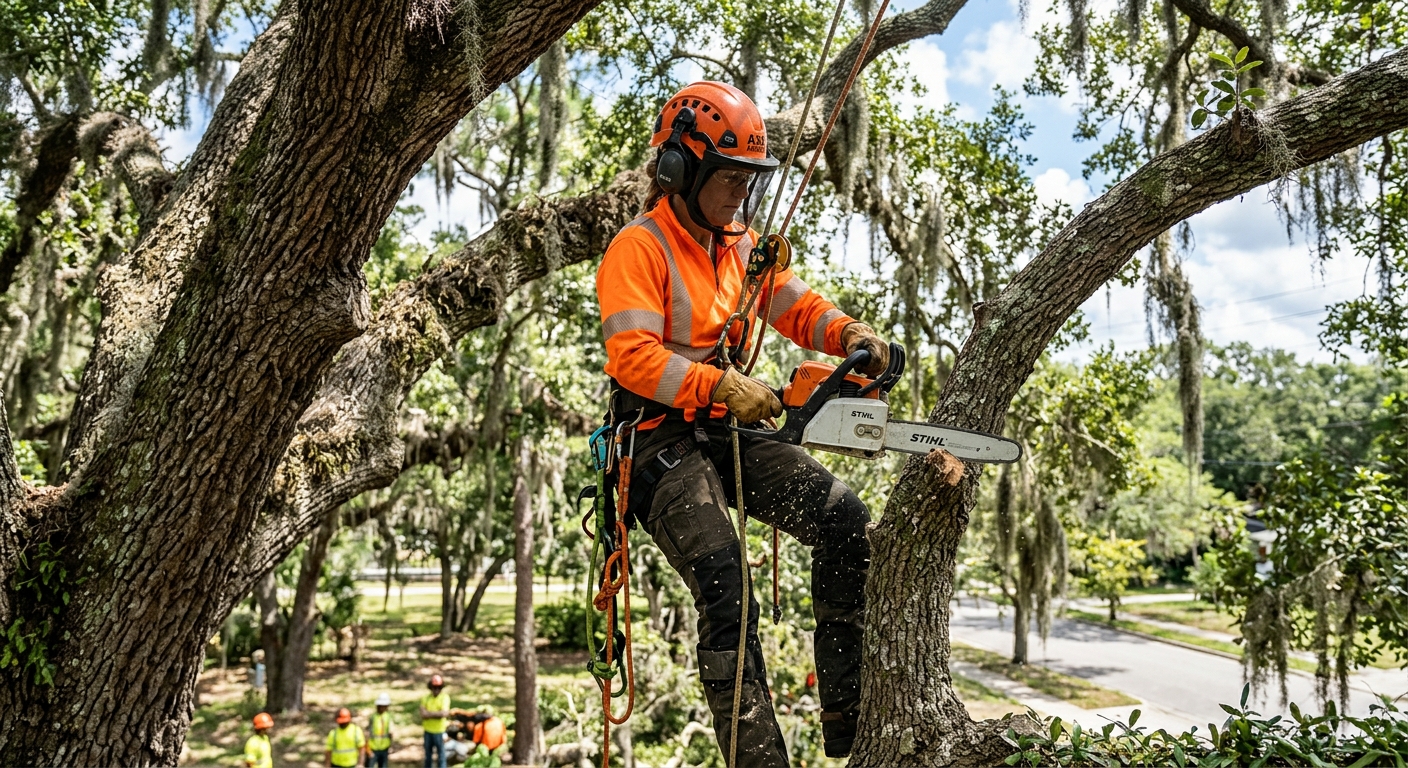
Essential safety gear for tree work includes a forestry helmet with face shield and ear protection, chainsaw-resistant chaps, steel-toe boots, heavy leather gloves, and safety glasses — yet most Jacksonville homeowners attempting DIY removal skip at least half these items. A proper forestry helmet costs $80–$150 and protects against falling branches, sawdust, and chainsaw contact; a regular construction hard hat doesn't include the required face shield or ear protection for chainsaw noise. Chainsaw chaps contain layers of Kevlar-like fibers that jam the chain and stop it within milliseconds if it contacts your leg — without chaps, a chainsaw running at full speed cuts through bone in under one second. Professional arborists also use climbing harnesses, fall-arrest lanyards, and rope-access systems certified by ANSI standards. When you're 30 feet up a tree with a running chainsaw, safety gear is the only thing between you and a fatal fall or laceration.
- Forestry helmet with face shield and ear muffs: $80–$150
- Chainsaw chaps (Kevlar fiber layers): $60–$100
- Steel-toe logging boots with ankle support: $100–$200
- Heavy leather gloves with chainsaw grip: $20–$40
- ANSI-rated climbing harness (for professional use): $150–$300
- Safety glasses with side shields: $10–$20
Professional-Grade Equipment: Bucket Trucks and Chippers vs Rental Options
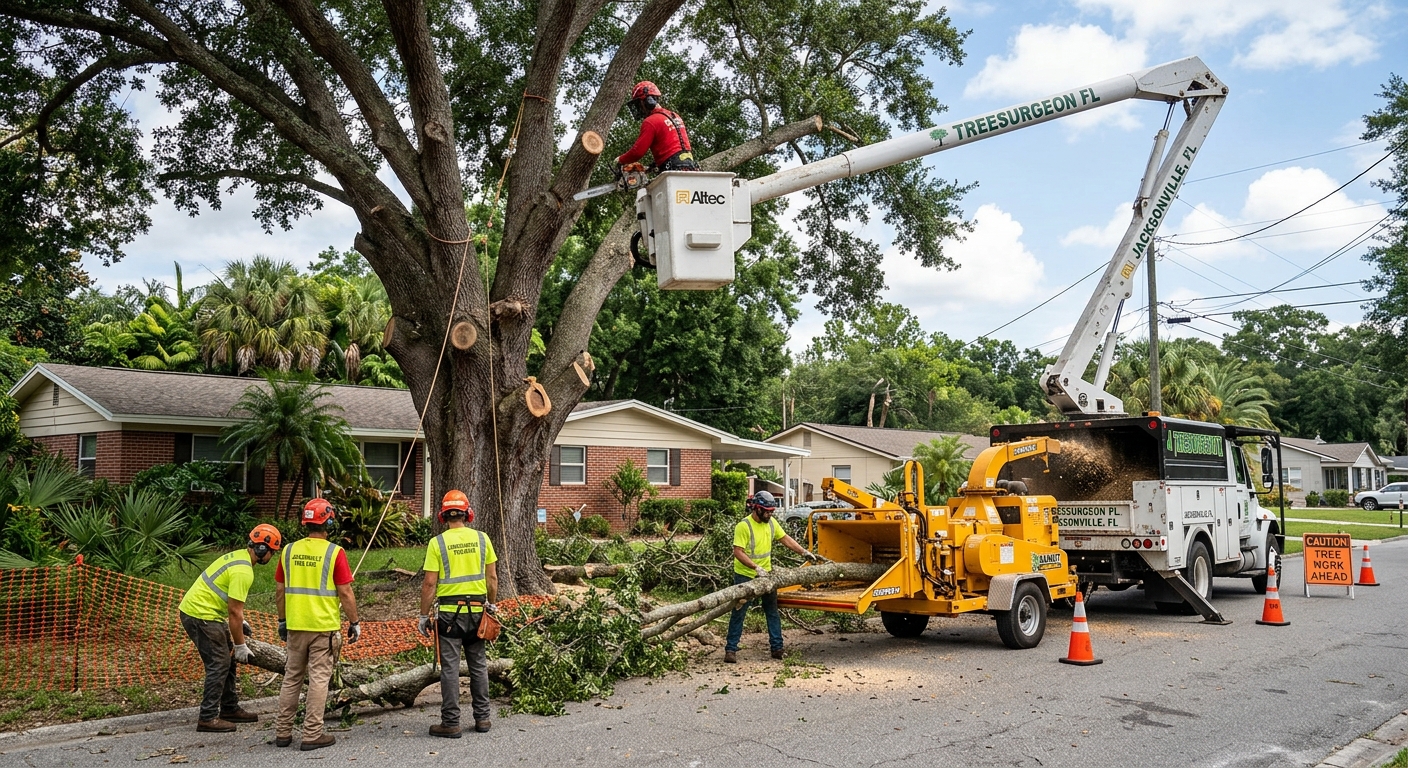
Professional-grade equipment like bucket trucks, whole-tree chippers, and stump grinders represent a $200,000+ investment that separates licensed tree services from DIY attempts in Jacksonville. A bucket truck provides stable aerial access up to 60 feet with 360-degree rotation — eliminating ladder falls and allowing arborists to position precisely for controlled cuts. Commercial wood chippers process 8–12 inch diameter logs at 50+ feet per minute, turning an entire tree into mulch in under an hour. Stump grinders with 60+ horsepower motors and carbide teeth remove 24-inch stumps in 15–20 minutes, grinding 12 inches below grade. Rental options for homeowners include consumer chainsaws (40cc engines vs professional 60–80cc), 6-inch capacity chippers (vs 12-inch), and walk-behind stump grinders that take 2–3 hours per stump. The rental equipment works, but operates at 1/3 the speed and requires experience to use safely. You can't rent a bucket truck without commercial licensing and insurance.
- Bucket truck (professional): $80,000–$120,000 purchase, provides safe aerial access to 50–60 feet
- Commercial wood chipper (professional): $25,000–$50,000, processes 12-inch logs at 50 ft/min
- Stump grinder (professional): $15,000–$35,000, removes 24-inch stumps in 15 minutes
- Consumer chainsaw rental: $75/day, 40cc engine, struggles with trunks over 12 inches
- Residential wood chipper rental: $200/day, 6-inch capacity, requires multiple passes for large limbs
- Walk-behind stump grinder rental: $150/day, takes 2–3 hours per stump for inexperienced users
Why Renting Equipment Adds Up Faster Than You'd Expect
Renting tree work equipment adds up faster than Jacksonville homeowners expect because jobs take 3–5 times longer without professional experience and you're paying daily rates. A chainsaw rents for $75 per day, but if you've never felled a tree, you'll spend the first day learning how to make proper notch cuts, back cuts, and hinge wood — meanwhile the rental clock ticks. Wood chipper rental costs $200/day, but processing debris from a 30-foot tree takes an inexperienced operator an entire day; professionals with larger machines finish in 90 minutes. If you rent a stump grinder for $150/day and spend 3 hours on one stump because you're learning carbide tooth positioning and depth control, you're paying $50/hour plus the physical exhaustion. Add the weekend extension fees most rental companies charge, and a "simple" DIY removal that takes Friday through Sunday costs $600–$800 in rental fees alone — before disposal, safety gear, or lost wages. At that price point, hiring a professional tree service that completes the job in 4 hours with full liability insurance makes financial sense.
Compare rental costs to professional service by calling (904) 634-3474 for a free Jacksonville tree removal quote. You'll see the real numbers and make an informed decision.
Jacksonville Tree Removal Permits and Regulations
Jacksonville tree removal permits and regulations protect heritage trees, environmentally sensitive species, and neighborhood canopy coverage through city ordinances that many homeowners don't discover until code enforcement issues fines. The City of Jacksonville Tree Protection Ordinance requires permits for removing certain protected trees, with fines starting at $500 for violations and escalating to $5,000+ for cutting heritage oaks without authorization. Tree removal regulations vary by zoning district, tree size, and species — what's legal in a commercial zone may be prohibited in residential neighborhoods. Homeowners associations add another layer of restrictions, often requiring architectural review board approval before removing any tree over 6 inches in diameter. Ignoring these regulations doesn't just risk fines; it can delay property sales, trigger neighbor complaints, and result in mandatory replanting requirements that cost more than hiring a professional tree service from the start.
Protected Trees in Jacksonville: Heritage Oaks and Regulated Species
Protected trees in Jacksonville include heritage live oaks, designated specimen trees, and any tree over a certain size threshold measured in diameter at breast height (DBH). Live oaks with a trunk diameter exceeding 12 inches require city permits for removal in many Jacksonville residential zones; heritage oaks — those designated for historical or environmental significance — are protected regardless of size and require City Council approval to remove. Other regulated species include bald cypress, longleaf pine, and trees within designated tree preservation areas shown on plat maps. Even dead or diseased protected trees require an arborist's written assessment confirming the tree is hazardous before the city issues a removal permit. Jacksonville's Tree Protection Ordinance aims to maintain urban canopy coverage, especially in older neighborhoods where mature oaks provide storm water management and property values. Professional tree services in Jacksonville handle permit applications as part of their service, including documentation, site plans, and arborist certificates that DIY homeowners struggle to provide.
- Live oaks over 12 inches DBH require removal permits in most residential zones
- Heritage trees designated by the city need City Council approval regardless of condition
- Bald cypress, longleaf pine, and other native species have protection thresholds
- Tree preservation areas shown on property plats prohibit removal without mitigation plans
- Even hazardous trees require ISA-certified arborist documentation before permit approval
Florida Tree Removal Permits: When You Need One and What It Costs
Florida tree removal permits vary by municipality, but Jacksonville requires permits for protected species, trees over specified size limits, and removal within environmentally sensitive areas. Application costs range from $50 for a basic residential permit to $500+ for commercial properties or heritage tree removal requests that require environmental review. The permit process takes 2–6 weeks depending on tree size and location — emergency removals for storm-damaged trees can be expedited with proper documentation from a certified arborist. You'll need a site survey showing the tree location, photographs from multiple angles, measurements of trunk diameter and canopy spread, and a statement explaining why removal is necessary. Many homeowners discover permit requirements only after cutting a tree and receiving a code violation notice from neighbors or city inspectors. Licensed tree removal companies include permit application in their service quotes and have established relationships with Jacksonville code enforcement that streamline approvals. Attempting to remove a permitted tree without authorization can result in stop-work orders, fines of $500–$5,000, and mandatory replanting with larger specimens.
- Basic residential tree removal permit: $50–$150
- Heritage oak or specimen tree permit: $200–$500
- Permit processing time: 2–6 weeks (expedited for hazardous trees)
- Required documentation: site survey, photos, DBH measurements, removal justification
- Violation fines: $500 first offense, escalating to $5,000 for heritage trees
- Mandatory mitigation: replanting requirements often exceed original removal cost
HOA Restrictions and Neighbor Liability in Jacksonville Neighborhoods
HOA restrictions in Jacksonville neighborhoods often exceed city regulations, requiring architectural review board approval for any tree removal visible from the street or neighboring properties. Many Southside, Ponte Vedra, and Mandarin subdivisions prohibit removing trees over 8 inches DBH without HOA consent, even if the city doesn't require a permit. HOA approval processes take 30–60 days and may include requirements for landscape plans showing replacement trees, neighbor notification, and board meeting presentations. Neighbor liability becomes a concern when tree removal damages adjacent properties — if your DIY tree removal drops a limb onto your neighbor's fence, you're personally liable for repairs because homeowner insurance excludes negligent tree work. Florida's premises liability laws also make you responsible if a tree you're cutting falls onto a neighbor's property and causes injury. Professional tree services carry $1–2 million in liability coverage that protects both your property and neighboring homes, eliminating these legal risks entirely.
Navigating Jacksonville tree permits and HOA requirements? Call (904) 634-3474 for professional guidance. We handle all permitting, documentation, and compliance so you avoid fines and delays.
Homeowner Insurance and Liability: What You Need to Know
Homeowner insurance and liability issues surrounding DIY tree work catch Jacksonville residents off guard when they discover their policies exclude coverage for self-inflicted property damage and injuries. Most homeowner's insurance policies cover tree removal only when a covered peril — hurricane, lightning, ice storm — causes the tree to fall and damage insured structures. They don't cover DIY tree work gone wrong. If you're cutting down a tree in your Jacksonville yard and it falls onto your roof, your insurance company will likely deny the claim because you caused the damage through elective activity. Liability insurance also excludes coverage when your DIY tree work damages a neighbor's property — that fence you crushed becomes a personal debt you must settle out-of-pocket. Professional tree services carry commercial general liability insurance and workers' compensation that protect your property, your neighbors, and the crew performing the work.
Does Your Homeowner's Insurance Cover DIY Tree Work?
Homeowner's insurance does not cover DIY tree work in the vast majority of policies — coverage applies only to trees that fall due to covered perils like hurricanes, windstorms, or lightning, and even then only if the tree damages an insured structure. If you decide to remove a healthy tree and it damages your house, fence, or vehicle during the DIY removal process, expect a claim denial. Insurance companies classify elective tree removal as maintenance activity similar to roof repairs or deck building — you assume full financial responsibility for any damage that occurs. The exception: if a tree falls naturally and damages your Jacksonville home, most policies cover removal costs up to $500–$1,000 per tree as part of debris removal. Some policies explicitly exclude coverage for tree work performed by unlicensed contractors or homeowners, meaning even hiring a cut-rate uninsured tree service can void your coverage. Always verify your specific policy language and consider that the $800 you save on DIY removal could cost $15,000 in uninsured roof repairs.
- Homeowner's policies cover tree removal only when covered perils cause damage to insured structures
- DIY tree removal damage is excluded as self-inflicted loss
- Debris removal coverage maxes out at $500–$1,000 per tree in most policies
- Using unlicensed contractors or DIY work can void coverage for related damage
- Read your policy's "trees, shrubs, and plants" section for specific exclusions
Liability If Damage Occurs During DIY Tree Removal
Liability for damage during DIY tree removal falls entirely on the homeowner when a falling tree or limb damages neighboring property, vehicles, or causes injury. Florida premises liability laws make property owners responsible for harm caused by activities on their land — if your tree falls onto your neighbor's Jacksonville home because you miscalculated the drop zone, you're personally liable for repairs. That can mean $10,000–$50,000+ in out-of-pocket costs depending on structural damage. If someone is injured on your property during DIY tree work — even a volunteer friend helping you — you're liable for medical expenses, lost wages, and pain and suffering damages. Homeowner liability coverage typically excludes DIY construction and tree work because insurers consider these high-risk activities. Even if your policy does provide some coverage, deductibles and premium increases after a claim often exceed the cost of hiring a professional tree service. The legal risks compound if you're working on storm-damaged trees after a hurricane — failure to properly secure your property creates attractive nuisance liability if a falling limb injures someone weeks later.
- Property damage to neighbors is your personal liability under Florida law
- Injury to helpers or bystanders creates medical and legal liability
- Homeowner liability coverage often excludes high-risk DIY activities
- Claims trigger deductibles ($500–$2,500) and premium increases
- Lawsuit defense costs alone can reach $20,000+ even if you win
Professional Tree Service Insurance Protection
Professional tree service insurance protection includes commercial general liability coverage of $1–2 million, workers' compensation for crew injuries, and property damage coverage that protects your Jacksonville home if anything goes wrong. When you hire a licensed tree removal company, their insurance becomes the primary coverage for any damage that occurs during the job — if a limb falls onto your roof, the tree service's liability policy pays for repairs without affecting your homeowner's insurance or triggering deductibles. Workers' compensation coverage protects you from liability if a crew member is injured on your property — without this, you could face lawsuits for medical bills and lost wages. Reputable Jacksonville tree services carry proof of insurance and provide certificates of coverage before starting work. This insurance costs tree services $15,000–$40,000 annually, but it's included in their service rates and provides you with financial protection worth exponentially more than the DIY "savings" you'd gain cutting costs.
Verify insurance coverage before hiring any Jacksonville tree service — call (904) 634-3474 and ask for our certificate of insurance. We carry full commercial liability and workers' comp protection for every job.
Why Jacksonville Homeowners Trust Professional Tree Services
Jacksonville homeowners trust professional tree services because certified arborists bring training, equipment, and local expertise that DIY attempts can't match — especially when dealing with hurricane-damaged oaks, permitting requirements, and liability risks unique to Northeast Florida. Choosing a licensed tree removal company means working with ISA-certified professionals who have completed hundreds of removals safely, carry insurance that protects your property and neighbors, and understand Jacksonville's Tree Protection Ordinance and code requirements. Trust is built through transparency — itemized quotes, clear timelines, and honest assessments of whether a tree truly needs removal or can be saved through canopy trimming and cabling. The best Jacksonville tree services have served local neighborhoods for 10–20+ years, earning reputations for showing up on time, finishing within the quoted price, and leaving properties cleaner than they found them.
Certified Arborists and ISA Standards in Jacksonville
Certified arborists trained to International Society of Arboriculture (ISA) standards represent the professional credential that separates legitimate Jacksonville tree services from unlicensed "tree guys" with chainsaws. ISA certification requires passing a comprehensive exam covering tree biology, proper pruning techniques, hazard assessment, rigging, and safety protocols — plus 30 hours of continuing education every three years to maintain the credential. A certified arborist can diagnose tree diseases, identify structural weaknesses invisible to untrained eyes, and determine whether a tree needs removal or can be saved through selective pruning and cabling. They follow ANSI